

Common Mistakes in Building a Business Model Canvas: Pitfalls and How to Avoid Them
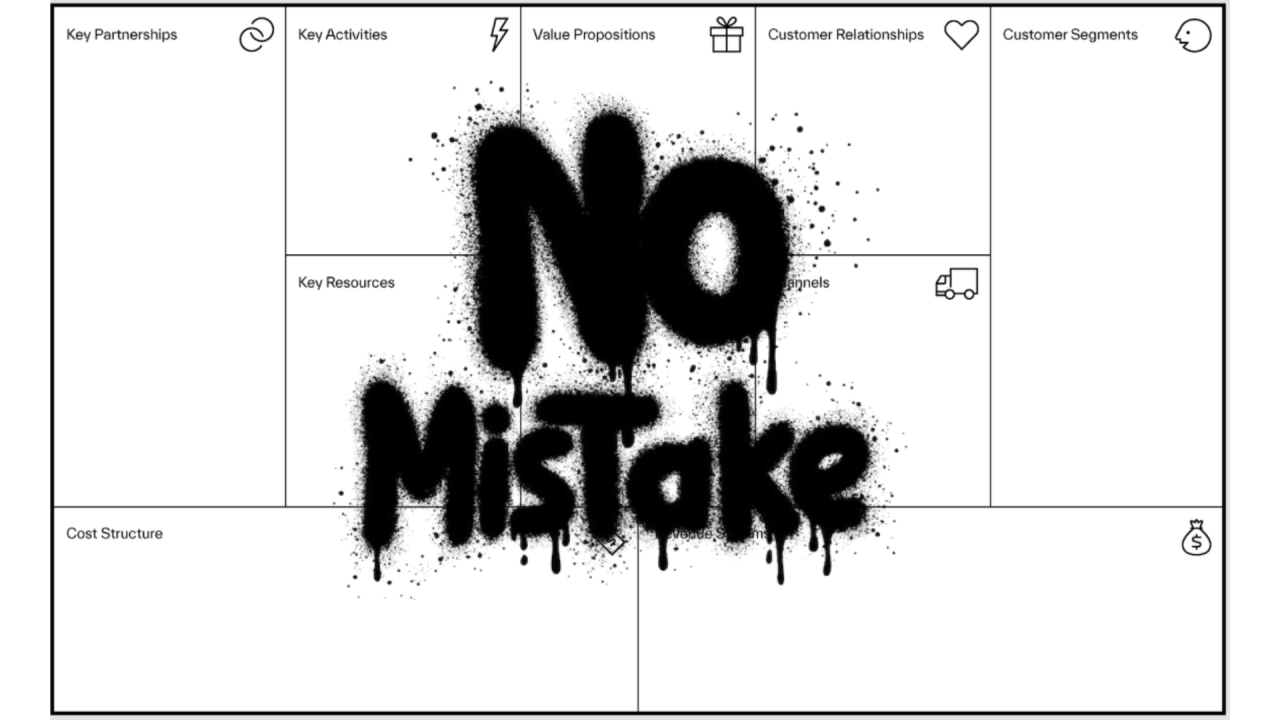
Many in business are familiar with the Business Model Canvas (BMC), made famous by Alexander Osterwalder. It’s a brilliant framework, no doubt about it. But like many tools that become the “go-to” in business, it can easily slip into something we do because we’re told it’s best practice, rather than something we really use to drive the business forward.
The Business Model Canvas is a one-page strategic tool that helps visualise and assess a business idea. It is much simpler than a lengthy business plan and breaks the business down into nine key elements. The right side focuses on external, customer-related factors, the left on internal business operations, and the centre highlights the value exchanged between the business and its customers.
The BMC can be a useful strategic tool but is only as powerful as its application. At RIKON, having completed over 800 business model projects with companies of all shapes and sizes, we’ve seen a clear pattern. Businesses often dive in with great energy, fill out the nine boxes, and end up with a canvas that looks neat on paper…. but in reality – it doesn’t deliver much for the company in practice.
So, what goes wrong? Let’s look at some of the most common mistakes businesses make with the BMC and more importantly – how you can avoid them.
#1 Confusing Products with Value Propositions
This is probably the most common trap we see. When businesses get to the “Value Proposition” box, they often just list out their products or services. It feels natural and we are comfortable talking about our product, but that’s not what the canvas is asking. The BMC isn’t about what you sell, it’s about the value your customers actually get from it.
How to fix it: Start by describing your product or service, yes, the features matter. But then take a step back and ask yourself: what problem does this solve, or what need does it fulfil for the customer? That’s where your real value proposition, and value to your customer, lies.
For example:
- Product: “We sell package holidays.”
- Value Proposition: “We give families stress-free travel experiences.”
See the difference? The first is what you do. The second is why it matters to your customer. Remember customers buy value not features.
# 2 Overgeneralising Customer Segments
Another common mistake we see is when businesses write something broad like “everyone” or “ All SMEs” in the Customer Segments box. On the surface it feels inclusive, but the truth is, if you try to serve everyone, you’ll struggle to resonate with anyone.
How to fix it: Get specific! Break your customers into clear segments based on needs, behaviours, or pain points. Ask yourself: who really benefits most from what we offer? The more focused you are, the easier it is to align your value proposition, channels, and relationships with their expectations.
For example:
- Too broad: “SMEs.”
- Sharper focus: “Owner-managed retail SMEs in the South of Ireland who struggle with supply chain complexity.”
See the difference? The first is vague. Essentially it is all companies in the world. Not all SMEs are generic, they differ in size, market and challenges and you have to understand those differences. The second gives you something concrete to work with and a much stronger foundation for strategy.
#3 Ignoring the Interconnections
It’s tempting to treat the nine boxes of the Business Model Canvas like nine separate checklists. Fill them in, tick the box, job done. But that’s not how the canvas works. Each block is connected, and a decision in one box will ripple through the others.
How to fix it: Think of the canvas as a system, not a set of silos. Every choice you make needs to be tested against the rest of the model. Ask yourself: if we deliver this value proposition, do our resources, activities, and cost structure support it?
For example:
- A company promises “24/7 live customer support” in its Value Proposition.
- But in Key Resources, it only lists a small customer service team working office hours 9-5.
See the difference? The promise and the resources don’t line up. If you ignore those interconnections, your business model quickly collapses under its own weight.
#4 Oversimplifying Revenue Streams
Believe it or not, this is probably the box on the canvas that gets the least attention. When businesses get to the revenue streams box, they often write down something simple like “sales” or “subscriptions” or “SaaS” and move on. It’s quick, it’s neat but it’s also a missed opportunity.
Every other box on the canvas costs your company money and the revenue stream is the one box that tells you how much money comes back into your company. Your revenue model is where innovation can happen, and oversimplifying it means you could be leaving serious money on the table.
At RIKON, you’d be shocked at how often we see companies give value away for free where services are bundled in that customers would happily pay for, or features that could easily be monetised but aren’t.
How to fix it: Take time to explore different ways value can be monetised. Ask yourself: are there alternative revenue streams we’re overlooking? Could you add tiered pricing, licensing, freemium models, transaction fees, or even advertising or entirely new models? Even small changes here can transform the profitability of your business model.
For example:
- Basic approach: A software company charges a flat annual licence fee.
- Smarter approach: The same company introduces tiered pricing (basic, pro, enterprise), adds a monthly subscription option, and creates a premium support add-on.
See the difference? One model limits growth. The other unlocks flexibility and matches different customer needs.
#5 Forgetting to Test Assumptions
One of the biggest mistakes we see with the Business Model Canvas is treating it like a finished plan instead of what it really is… a set of educated guesses. When you fill in those nine boxes for the first time, you’re working off assumptions. If you never test them, you’re basically building your business on guesswork.
How to fix it: Think of your canvas as a living hypothesis. Every box you fill in should spark a question: is this actually true? Then go out and test it. We have a saying in RIKON: you have to get out of your head and go talk to customers. That might mean talking directly to customers, running surveys, prototyping an idea, or launching a small Minimum Viable Product (MVP) to see if people will actually pay for what you’re offering.
For example:
- Assumption: “Our customers want a mobile app for booking.”
- Test: Build a simple landing page with a sign-up form for early access. If nobody signs up, maybe the app isn’t what they really need.
See the difference? Instead of pouring time and money into a fully built product, you validate the idea first. That way, your business model evolves based on evidence and fact and not gut feeling.
#6 Treating the Canvas as ‘One and Done’
This is probably the biggest pitfall of all. Too often, teams complete the Business Model Canvas during a workshop, feel good about the result, pin it up on the wall…and never look at it again. Fast forward six months, and the canvas is out of date, sitting on a shelf while the market and the business has already moved on.
How to fix it: Treat your BMC as a living document. Revisit it regularly, at least quarterly, or any time there’s a big change in your market, your customers, or your strategy. Use it as a tool for reflection, not a one-off exercise. When you update the canvas, you’re not just “filling boxes” again, you’re keeping your strategy aligned with reality. The real value of the BMC comes when it’s used as an ongoing guide, evolving alongside your business, rather than gathering dust.
If you would to discuss how your business model can be optimised why not contact RIKON at SETU at [email protected] or call us directly on 051 302409