

Understanding What a Business Model is | RIKON at SETU
“What is a Business model?” It’s one of those phrases that gets thrown around constantly. Funding agencies insist you have one. Investors want to know about it. Advisors emphasise it. Entrepreneurs swear by it. It pops up in pitch decks, boardrooms, and strategy sessions everywhere.
But here’s the catch. For a super popular term, it is often very much misunderstood. Ask ten different people to define it and you will likely get ten different answers. Some will point to your pricing strategy, others to your product. A few will equate it to your entire business plan. And many will simply refer to the Business Model Canvas, as if filling in nine boxes is the whole story.
No wonder the term feels a little confusing.
So let’s clear the fog once and for all. What is a business model, really? And why does it matter so much to the success (or failure) of your business
A Simple Way to Think About a Business Model
At its core, a business model is really just the story of how your business works. It explains how you create value, how you deliver that value to customers, and how you capture value back in return (usually as revenue).
Here’s a simple way to break it down into four questions:
- Who are your customers?
- What value are you giving them?
- How do you deliver it?
- And how do you make money from it?
That’s it. Strip away the jargon, and a business model is simply a structured way of answering those four questions.
Imagine you run a coffee shop.
- Your customers are busy commuters and local workers.
- Your value is great coffee, fast service, and maybe a cosy space to relax.
- You deliver through a physical shop in a convenient location, with takeaway options.
That’s your business model in action. It is not a fifty-page business plan, just a clear, simple story of how your business creates, delivers, and captures value.
How the Business Model Canvas Fits In
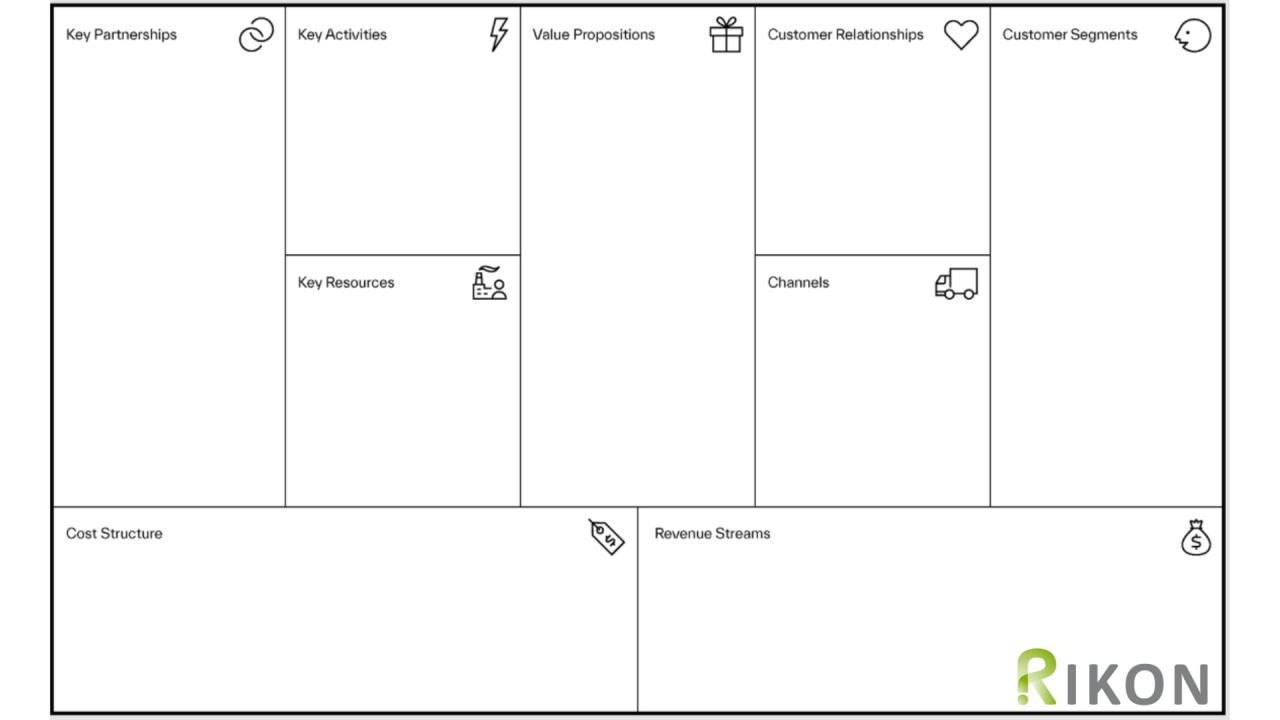
Now, if a business model is just the story of how your business works, the Business Model Canvas (BMC) is the tool that helps you tell that story in a structured way.
Developed by Alexander Osterwalder, the canvas breaks your business model down into nine building blocks:
- Customer Segments: Who you serve.
- Value Proposition: The value you promise to deliver.
- Channels: How you deliver that value.
- Customer Relationships: How you interact with customers.
- Revenue Streams: How money flows in.
- Key Resources: What you need to deliver value.
- Key Activities: What you must do to deliver it.
- Key Partnerships: Who helps you make it work.
- Cost Structure: What it costs to deliver.
The magic of the canvas is that it puts all nine elements on a single page. You can see not just what your business does, but how the parts fit together from the customer-facing side (right-hand blocks) to the operational engine room (left-hand blocks).
Instead of burying your model in a long report or business plan, the canvas lets you capture it visually, making it easier to spot gaps, assumptions, and opportunities.
Would you like to discuss your business model and how it may be optimised why not set up a call with the Business Strategists at RIKON at SETU email us directly at [email protected] or call us directly on 051 302409